Stack
Product Management Internship
Fall 2025
The Problem
Stack is an AI-driven healthcare training platform for clinical trial teams at academic medical centers. The company needed sharper signal on where demand was strongest and which product pillars would resonate most with cancer centers.
Clinical research coordinators face steep protocol complexity, high turnover, and training fatigue. Mistakes can create compliance risk and burden already-stretched teams. For Stack, the opportunity was to become the training backbone for academic medical centers — but only if the roadmap reflected real workflow pain and buyer priorities.
Approach
- —Conducted primary and secondary interviews with cancer center leaders to identify training, compliance, and operational pain points.
- —Synthesized customer signal across institutions to understand which use cases and product pillars had the strongest resonance.
- —Partnered with the CEO and CTO to translate insights into a prioritized 2026 roadmap, balancing customer value, engineering feasibility, and business priorities.
What I Delivered
- —Customer discovery synthesis across academic medical centers, including patterns in training pain points, protocol complexity, and unmet workflow needs.
- —Impact/feasibility framework to support roadmap tradeoffs and quarterly planning.
- —Prioritized 2026 roadmap with initiative sequencing across Stack's three pillars.
- —Reusable customer discovery infrastructure, including an interview guide and outreach tracker.
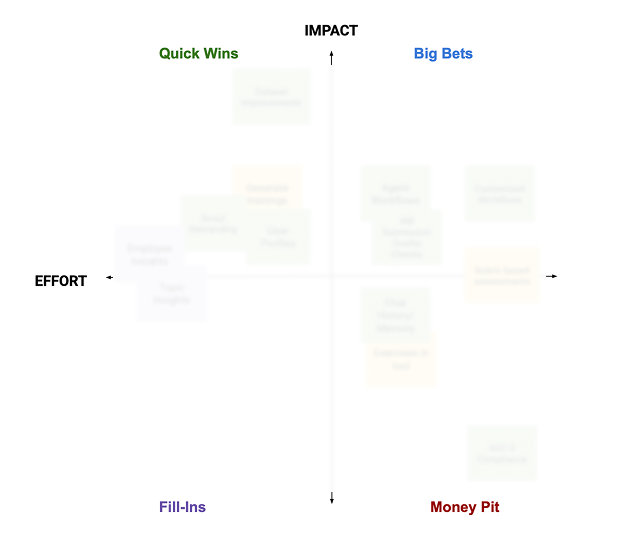
Impact vs. Effort feature prioritization framework. Company-specific details redacted for confidentiality.
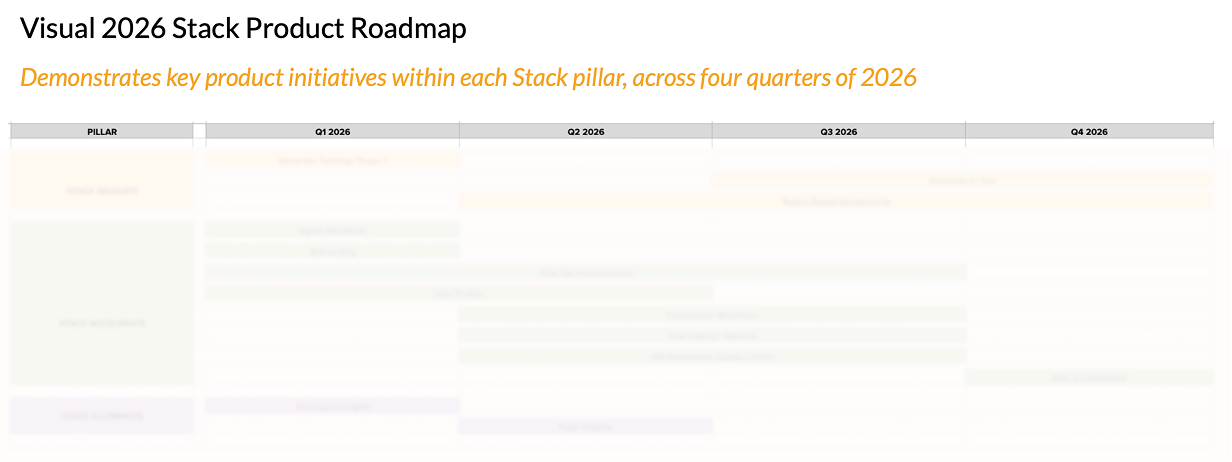
2026 Stack Product Roadmap spanning all pillars. Company-specific details redacted for confidentiality.
Outcomes & Takeaways
- —Grounding roadmap decisions in customer discovery made prioritization more concrete and defensible.
- —Impact/effort scoring created a shared decision-making framework across business and technical stakeholders, helping the team align and weigh tradeoffs between customer value and engineering feasibility.
- —Building reusable research, prioritization, and roadmap artifacts created a foundation the team could continue using beyond the project.
What I’d Do Next
- —Convert strongest interview relationships into pilot conversations with target institutions.
- —Test roadmap assumptions with customers using lightweight prototypes.